


CAN bridge
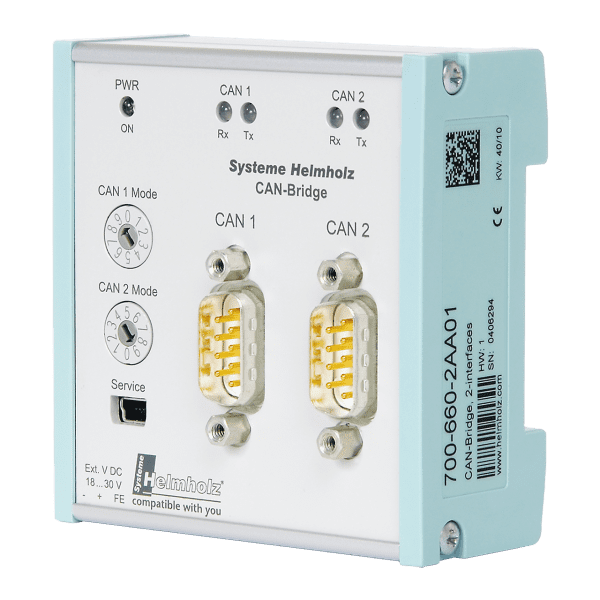
The CAN bridge enables the coupling of two similar or different CAN networks.
Description
It can work as a message repeater to increase the network size, as well as connect different CAN networks with each other. When transmitting messages, it is irrelevant whether the CAN networks have different transmission rates or whether the messages are part of different higher-level protocols, such as. B. CANopen® and a proprietary protocol.
A flexibly adjustable filtering logic can accept freely selectable identifiers and implement them on the other network.
The CAN messages are forwarded to the other CAN network and sent out again according to the store-forward principle.
With the CAN bridge, the CAN networks are both physically decoupled (galvanic isolation) and the bus load on both CAN networks is reduced. The CAN bridge allows a flexible design of the network topology; star and tree structures as well as extensive line structures can be implemented. The CAN bridge can be configured for simple applications using the two rotary coding switches.
For more complex applications, the filtering and forwarding of CAN telegrams can be flexibly adjusted using the included CAN bridge parameterization software.
Up to 256 range filters and up to 4 bit filters are available for address filtering. The configuration is imported via a USB interface and can also be read out again.
The CAN bridge works in both 11-bit and 29-bit modes and can communicate with transfer rates of 10 Kbit/s up to 1 Mbit/s. It has a powerful microcontroller that can work even at the highest data rates and bus loads without loss of messages. 5 LEDs signal the status of the device and the connected CAN networks.
- Increasing the network extent
- Connecting different CAN networks (Different transfer rates/messages belonging to different higher level protocols)
- Physical decoupling (galvanic isolation)
- Reduces bus load on both CAN networks
- Automatic detection of transfer rates
- Easy configuration mode
- Can be used with CAN 2.0A & 2.0B, CANopen, DeviceNet, SAE J1939
- DIN rail mounting
TECHNICAL SPECIFICATIONS
General information
- Order number: 700-660-2AA01
- Product Name: CAN bridge, 2 x CAN bus connections
- scope of delivery: CAN bridge, manual, software, USB programming cable
- Dimensions (DxWxH)” 31x74x75mm
- Weight: approx. 130 g
CAN interface
- Number: 2
- Type: ISO/DIN 11898-2 CAN High Speed physical layer
- Transfer rate: 10 Kbit/s … 1 Mbit/s
- protocol: CAN 2.0A (11 bit)/CAN 2.0B (29 bit) Layer 2, transparent
- Connection: Plug, SUB-D, 9-pin
- Features: automatic detection of the transmission rate or permanently adjustable
Status display
- Status display: 5 LEDs
Project planning interface
- Type: USB 1.1
- Connection: Mini USB socket
Power supply
- Operating voltage: 24 V DC (18…30 V DC)
- Current consumption typical: 35mA
- Current consumption maximum: 60mA
Environmental conditions
- Ambient temperature: -25°C … +60°C
- Transport and storage temperature: -25 °C … +75 °C
- Pollution level: 2
- Protection class: IP20
- Approvals: CE
DOWNLOAD
| Surname | version | Size | |
| CAN bridge, manual | 1 | 444KB | Download |
| EU declaration of conformity | 05-2019 | 70KB | Download |
| Surname | version | Size | |
| CAN BridgeParam | 2 | 23MB | Download |
| CAN bridge, firmware history | 128 B | Download |
| Surname | version | Size | |
| CAN bridge, USB driver | 2.12.24 | 1,014KB | Download |
| Surname | version | Size | |
| CAN bridge, STEP data | 2MB | Download | |
| CAN bridge, macros for EPLAN | 1MB | Download |
Related products
-
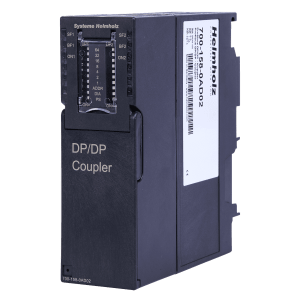
DP/DP coupler
Add to quote -
SFP Module
Select options This product has multiple variants. The options may be chosen on the product page -
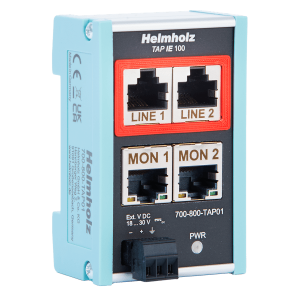
Diagnosis
Add to quote -
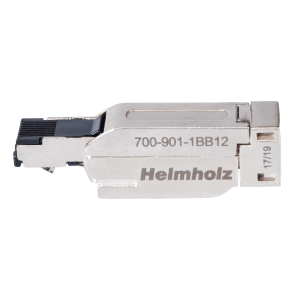
Industrial Ethernet Connector
Select options This product has multiple variants. The options may be chosen on the product page

Leave a Reply